Marie Jeanne HOLVECK
Where to find me
Centre d'Ecologie Fonctionnelle et Evolutive CEFE, CNRS-UMR 5175
CNRS campus
1919, route de Mende
34293 Montpellier 5
France
(Last update 05/11/2020)
Home
 In the News
November 2019:
I signed #ScientistsWarningtoHumanity about climate emergency. Please share the link to the paper (https://doi.org/10.1093/biosci/biz088) to promote reading and taking rapid actions.
The first paper of Doriane Muller's PhD thesis was accepted in Plos One. Congrats Doriane! (P25, in "Publications" tab)
May 2019:
Participant to the #WeChangeForLife collaborative initiative: [CALL FOR TESTIMONIES] 250 scientists, who are also citizens, testify to the changes they made in their lives and to their wishes so that the environment would be respected. And you, what have you already done? Contribute on https://wechangeforlife.org.
Just back at CEFE-CNRS and already a paper accepted in Biological Journal of the Linnean Society! This study experimentally shows that eggshell colouration reflects the condition of female blue tits during egg-laying, indicating that this trait is potentially an intra-specific signal and under sexual selection. (P24, in "Publications" tab)
December 2018:
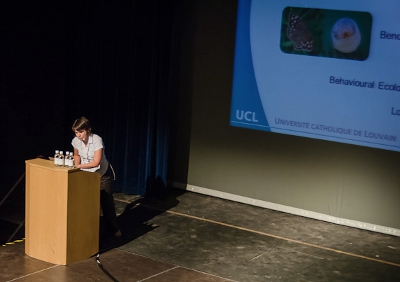
A talk accepted at the Benelux Congress of Zoology to present an example of a potentially maladaptive response to climate change under sexual selection in a butterfly. The speaker is Doriane Muller. (T-37, in "Research promotion" tab)
November 2018:
A paper accepted in Journal of Avian Biology. The study suggests that great tits build shallower nests, farther from nest entrance, to avoid intense artificial light at night (e.g. to improve sleep). The potential nightlight benefits of these nests (e.g. reduced building effort and predation risks, yet at the potential daylight costs of e.g. not procuring enough light or heat) may partly explain the equal reproductive success of urban and rural great tits. (P23, in "Publications" tab)
May 2018:
A poster accepted at the II Joint Congress on Evolutionary Biology! (P-35 in "Research promotion" tab)
February 2018:
New project (Vespatrap) at INRA PACA and AMAP with an AGREENSKILLS+ fellowship!
January 2018:
A paper accepted in Frontiers in Zoology. This commentary aims at raising researchers' attention on several methodological and conceptual aspects of laboratory experiments that distort the social environment compared to natural conditions. In particular, we stress that any work performed in laboratory conditions using extreme cage densities or sizes impedes female mate choice and promotes male-male competition when sexual conflict occurs about mating decisions. (P22, in "Publications" tab)
October 2017:
Two posters accepted at the ASAB Winter Meeting on Sexual selection: Do we still need to test the alternatives? and the BES, GFÖ, NECOV and EEF Joint Annual Meeting: Ecology across borders! (P-32 and P-33, respectively, in "Research promotion" tab)
June 2017:
A paper accepted in Behavioral Ecology and Sociobiology. This quantitative synthesis of the avalaible literature on a butterfly extensively studied for mate choice in the lab shows how the lab social environment in which experiments are conducted can bias mating patterns and thus our extrapolation to the evolution of sexually-selected traits in the wild. (P21, in "Publications" tab)
A talk accepted at the Behaviour 2017 meeting in Estoril, Portugal! (T-31 in "Research promotion" tab)
May 2017:
First paper from my current project at CEFE, in press in Biological Journal of the Linnean Society! Results suggest that predation, sexual selection and clutch recognition may simultaneously drive eggshell colour evolution in kittiwakes. (P20, in "Publications" tab)
February 2017:
Two posters accepted at the Congress of the European Society for Evolutionary Biology ESEB! (P-29 and P-30 in "Research promotion" tab)
January 2017:
A paper accepted in The American Naturalist thanks to a nice collaboration with Franck Hollander, Nicolas Titeux and Hans Van Dyck! (P19, in "Publications" tab)
December 2016:
Two talks accepted at Belgium conferences thanks to the very good work of Caroline Nieberding's team, in particular Doriane Muller and two Master students, Arthur Timmermans and Lidwine Colonval! (T27 and T28, in "Research promotion" tab)
October 2016:
A paper accepted in Scientific Reports thanks to a nice collaboration with Hans Van Dyck! (P17, in "Publications" tab)
Research summary
In the context of behavioural, sensory and evolutionary ecology, my research activities aim at understanding how variation in communication (signal production and perception, cognition) influences (i) the evolution of multisensory signalling (acoustic, visual, chemical) and (ii) the adaptation (or not) of populations (phenotypic plasticity, genetic variability) to rapid environmental changes, particularly of anthropogenic nature such as climate change, urbanization or biological invasions. I combine complementary approaches (correlative, experimental, comparative; in the field and in the laboratory) on various biological models (birds, frogs, insects, plants) to answer fundamental and applied questions related to signals and their perception.
In the past 15 years, while researchers interested in animal communication were mostly focused in studying information transmission from the sender point of view, in my research, I have simultaneously studied how variation in the processes of perception and cognition of receivers influences the evolution of multisensory signalling, a topic for which there is nowadays an increasing growing interest in ecology.
Keywords
General fields: Behavioural biology and ecology - Sensory ecology - Evolutionary ecology - Functional ecology - Population biology - Biostatistics
Themes: Animal multimodal communication - Sexual selection - Phenotypic plasticity - Eco-evo-devo - Social learning - Maternal effects
Biological models: Birds - Frogs - Insects - Plants
Techniques: Biological material sampling (blood, feathers, eggs, tissue, chemical compounds) - Descriptive, empirical and comparative approach (field, laboratory) - Fine-scale behavioural observations - Laboratory breeding stock management - Metabolic rate - Population survey - Bioacoustic, chemo-sensorial, electo-physiologic (GC-EAD), photographic, spectrophotometric and statistical analyses
Additional keywords: Acoustic, chemical and visual signalling – Capture-Mark-Recapture - Coloration – Competition – Condition, context and density dependence – Dispersal – Ecological traps – Flight – Functional behaviour, morphology and physiology – Gene-by-environment interactions – Life history and mating strategies – Lifestyles – Mate choice – Mating and reproductive success – Olfactometry - Operant conditioning - Pheromones – Physiological models of vision – Preference - Reaction norms – Secondary sexual traits - Sex ratio – Song - Volatile organic compounds